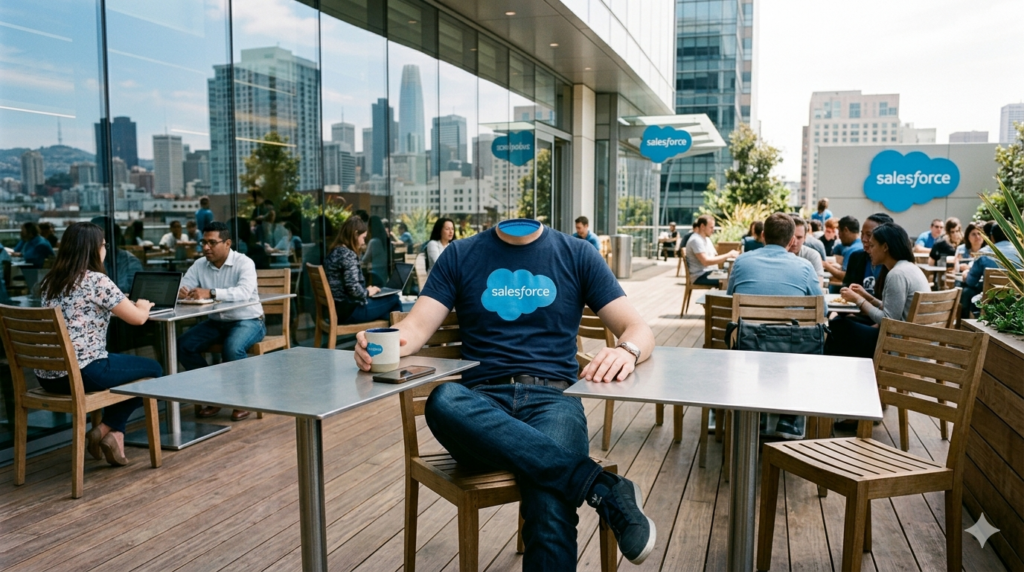
When the interface disappears, the discipline of what gets surfaced becomes the entire product. Most companies haven’t built that discipline yet.
Salesforce announced last week that its entire platform is now exposed via APIs for AI agents to access directly. No UI required. Agents call the platform, do the work, and return the result. The screens, the things that took twenty years to build, sell, and train customers on, become optional. In some configurations, they become irrelevant.
The dominant take in my feed has been some version of “agents are the new interface.” That’s true, and it’s also half the story. The half nobody is talking about is the half that decides who wins the next decade of B2B software.
What “headless” actually means in plain language
Salesforce, like every major SaaS platform, used to be a screen-first product. You logged in, navigated a UI, clicked through tabs, filled in fields, ran reports. The CRM was the screens. The data and logic underneath were technically separable, but in practice the product was the experience of using it.
Going headless changes that. The screens are no longer the product; the data and logic are. AI agents now talk directly to the platform, run the workflows, write the records, and surface results to the user. The user might never open Salesforce again. They might just open whatever lightweight surface their agent uses, such as chat, voice, SMS, or a single notification, and act on the result.
Every B2B SaaS company on earth is now staring at this and asking the same question. Should we be doing this? The answer, almost universally, is yes. The follow-up question is the one that matters: are we ready? Most are not, and the reason is not technical.
The obvious lesson, and the one underneath it
The obvious lesson from Salesforce going headless is that AI agents are eating the interface layer. That’s been clear for a while. I wrote about it in The Calm Operator months ago, and again in Ledo Everywhere when we shifted Phase 2 of Ask Ledo’s strategy to make Ledo the surface across every product we ship.
The lesson underneath is harder, and it is the one I want to spend the rest of this piece on. When the interface disappears, the discipline of what the agent surfaces becomes the entire product. The next ten years of B2B software is going to be decided by who built that discipline early and who is still trying to retrofit it after the fact.
What a dashboard actually was
To understand why this matters, we have to be honest about what dashboards have been for the last thirty years. A dashboard is a confession. It is the system saying: I don’t know what matters, so here is everything; you decide.
The KPI grid is not a feature, it is a refusal to make a judgment, dressed up as data visualization. The notification inbox is not a service to the user, it is a refusal to decide what is worth interrupting them for. The “everything in one place” pitch, repeated by every B2B platform from 2005 to 2024, was always a polite way of saying “we couldn’t decide what mattered, so we gave you the labor of deciding.”
We accepted this because we had to. The system couldn’t decide, so the human decided instead. The human carried the cognitive load of looking at twelve numbers, ignoring eight of them, recognizing that one was off, forming a hypothesis about why, and acting. Most of the human’s working day was spent doing the second job a dashboard quietly assigned to them, the job of being the system’s prefrontal cortex.
Headless changes that. The system can decide now. With agents in the loop, the system can look at the twelve numbers, ignore eight of them on its own, recognize the one that’s off, form a hypothesis, and surface a clear question to the human: should I do this? Yes or no. The dashboard becomes unnecessary, not because dashboards are bad, but because the work the dashboard was outsourcing to the human can finally be done by the system instead. But only if the system has been taught what to surface and what to refuse, and that is the part most companies are about to miss.
Where most companies will fail this transition
There is a predictable failure mode coming, and it is going to be the dominant pattern for the next eighteen months. Companies are going to expose their existing dashboards through agents. The agent will open the conversation by saying something like:
Good morning. Your pipeline coverage is down 12%. Your call volume is up 4%. Three deals have stalled in stage three. Your team’s response time is averaging 47 minutes. Your top rep closed two deals yesterday. There are 17 open follow-ups assigned to you. Your CSAT score moved up half a point. Would you like to act on any of this?
That is not an agent, it is a dashboard wearing a chatbot. The interface improved, the discipline didn’t. The user is doing exactly the same job they were doing before, looking at twelve numbers, ignoring eight, deciding which one matters, except now they are doing it through a chat window instead of a screen, which makes the experience marginally worse, not better.
This is the trap, and almost every B2B SaaS roadmap I have seen in the last quarter is walking directly into it. The headless transition is being treated as an interface project when it is, in fact, a discipline project. Discipline cannot be added at the end. It has to be the architecture from the start.
The Ledo Everywhere thesis, in full
This is the moment Phase 2 of Ask Ledo was built for.
We have been writing about Calm Intelligence since the company started, and the thesis has not changed: the next generation of business software will not win on capability. It will win on what the system refuses to do.
The Knowledge Center, which underlies every product we ship, is not a model. It is a discipline architecture. It ingests every customer interaction, every audit, every recommendation, every outcome. It validates those signals over time. It promotes them to learnings only when confidence crosses a threshold. It surfaces them, into Ledo’s working memory and into operator decisions, only when relevant, with a confidence score attached, and only one or two at a time. The whole architecture is built around the question of what we should refuse to surface, not what we can surface.
That is why LeadMachine opens to a single priority lead and three follow-ups instead of a CRM dashboard. That is why Ledo Says delivers a daily summary plus three specific next steps over SMS, not a notification feed. That is why AdMachine groups recommendations into three categories (Critical, High Priority, Monitor) and refuses leaderboards, refuses celebration UI, and refuses the urgency theater that most paid media tools mistake for value.
Those numbers (one priority, three follow-ups, three categories) came from argument, not capability. We arrived at them through many meetings, through cut features, and through the repeated decision to refuse the dashboard.
Now Salesforce is going headless, and eventually everyone else will too. The companies that have spent the last two years building discipline architectures are about to find that the moat they were quietly digging was the right one.
What this means for small founders
If you are a small founder reading this and feeling like the AI race is being won by the companies with the most compute, I want to push back on that directly.
The race for capability is over. It is commoditizing. The frontier moves every quarter, and if your moat is “we use the smartest model,” your moat lasts about six weeks.
The race for discipline is just starting, and it favors small teams with strong opinions over large teams with stakeholder management. Two operators arguing about whether something deserves a notification will produce a more disciplined agent than fifty engineers shipping every notification their PM was asked for. Discipline does not scale linearly with funding, and judgment does not scale at all. It either exists in the team or it doesn’t.
This is the opportunity almost no one is talking about, and it is going to be the defining advantage of the next decade.
What we’re shipping into this
LeadMachine is our AI CRM, live across multiple verticals. Focus Mode surfaces one priority lead with one reason and three follow-ups. There is no homepage dashboard, and operators tell us repeatedly that the silence is the feature.
Ledo Says is our ambient notification layer: a daily summary, three specific next steps, delivered over SMS or push. Operators can reply back agentically (saying something like “do step two”) and Ledo executes. There is no notification inbox and no digest email.
AdMachine is our Google Ads management platform, currently transitioning to a browser-based agent surface. Audits produce findings, findings produce recommendations, and recommendations are surfaced as a swipeable card stack. Operators approve or reject. There are no leaderboards, no celebration animations, and no urgency theater.
The Knowledge Center is the discipline architecture that underlies all of it.
The dashboard is dying. The discipline that should have replaced it isn’t built yet. That’s the opportunity.
— Jay
Related Reading
- The Calm Operator. The framework underneath every product decision we make.
- Calm Intelligence Is Not a Feature, It’s a Discipline. The thesis in full.
- Ledo Everywhere: What Phase Two of Ask Ledo Actually Means. Why we made Ledo the surface across every product.
- Ledo Anywhere: NASCAR AI CRM Proof of Concept. The thesis in the field.
- LeadMachine. The CRM that opens to one priority, not a dashboard.
Frequently Asked Questions
Going headless means Salesforce's data and logic layer is now fully exposed via APIs, so AI agents can access the platform directly without going through the traditional user interface. In practice, the user may never open Salesforce again. Their agent does the work and surfaces results through whatever lightweight surface they use, such as chat, voice, or SMS.
Not entirely, but they will replace the dashboard-and-form interface that has dominated B2B software for the last thirty years. The interfaces that survive will be small, surgical surfaces (a single decision, a single approval, a single notification) backed by an agent that has done the work of deciding what is worth surfacing.
Calm Intelligence is the design philosophy behind everything we build at Ask Ledo. Its core claim is that the next generation of business software will not win on capability. It will win on restraint, on what the system refuses to do. We have written about this in depth in Calm Intelligence Is Not a Feature, It's a Discipline.
Because model capability is commoditizing. The frontier moves every quarter, and a competitive advantage built on "we use the best model" lasts about six weeks. A competitive advantage built on operational discipline (what the system surfaces, what it refuses, how it integrates into the actual work) compounds over years and is much harder to copy.
LeadMachine is built around Focus Mode, which surfaces one priority lead with one specific reason and three follow-ups. There is no homepage dashboard, no KPI grid, and no notification inbox. The CRM is sophisticated underneath and almost embarrassingly simple on top, and that is intentional.
Start with the customer's actual workflow. Identify the moments in that workflow where the operator is currently doing the system's job, looking at numbers, deciding what matters, recognizing exceptions. Build an agent that does that work and surfaces a single clear question. Refuse to surface anything else. Then plug in whichever model is best this quarter. The model is interchangeable; the discipline isn't.