Jay Thornton

I’ve spent the last year trying to figure out why automation still feels broken — even when it’s working exactly as designed.

Triggers fire. Sequences run. Messages go out on time. On paper, everything is functioning. But in practice, automated communication often feels disconnected, mistimed, or oddly unaware of what’s actually happening.

That gap isn’t caused by a lack of tools. It’s caused by a lack of context.

Most automation systems are built around rules, not understanding. Something happens, so something gets sent. There’s no awareness of why the event occurred, what came before it, or whether the message still makes sense in the larger story.
That distinction matters more than most teams realize.

Why Rules Alone Don’t Scale Relationships

Rules are binary. Either a condition is met or it isn’t. But real business interactions don’t work that way.
A lead fills out a form after a sales call, not before it. A customer opens an email while already deep in a buying process. A follow-up arrives after the decision has been made — just not in your system.
When automation ignores those realities, communication becomes noise. It may still get opened. It may still technically “perform.” But it stops feeling intentional. At scale, that’s costly. Not just in unsubscribe rates, but in trust.

Context Changes Everything

Context-aware automation behaves differently. It doesn’t ask, “Did this event happen?” It asks, “What does this event mean?” That shift requires seeing more than one data point at a time. It means understanding engagement history, sales activity, timing, and intent — and using that broader picture to decide whether a message should be sent at all.

AI doesn’t fix this by default. Most AI in email tools is just a faster way to send the wrong message. The problem was never speed. It was awareness.

Fragmented Systems Can’t See the Whole Story

I’ve watched this firsthand. CRM data in one tab. Email platform in another. Sales notes in a third. Each system confident it’s doing its job, none of them aware of the others.

When systems can’t see the whole story, automation can’t act intelligently.

Bringing those signals together — behavior, engagement, timing, and outcomes — is the difference between automation that executes and automation that understands.
What I’m Building Toward

This is the gap I’ve been thinking about for the last year. Not smarter emails. Not cleverer sequences. Better decisions.

At LeadMachine.fyi, I’m designing automation around shared context — not just email triggers. The goal isn’t to send more messages. It’s to surface the right action at the right moment, based on what’s actually happening across a business, not just inside an inbox.
When automation understands context, it stops feeling automated. It starts feeling considered.

That’s the direction I’m pushing — both in how I think about systems and in what I’m building.
Because communication doesn’t break when tools fail. It breaks when understanding is missing.

~jt

Have questions or comments? Get in touch! I can even schedule a demo!

Get in Touch!

I’ve spent most of my career building SaaS products around a simple question:

Does this actually make someone’s work clearer and easier?

Over time, I’ve become increasingly skeptical of software that promises transformation but delivers more complexity. This is especially true in the CRM space. Most CRMs today are very good at collecting data and very bad at helping people understand what to do with it.

They track activity, store contacts, and generate reports. But when you ask the questions that matter in the moment, the answers are usually buried.

What should I work on today?
Which deals are moving and which are quietly stalling?
Where follow-up is slipping?
What activity is actually driving outcomes?

That gap isn’t a data problem. It’s a clarity problem.

That gap is why I built LeadMachine.

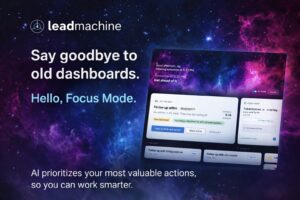
LeadMachine is an AI-enriched CRM designed around decision-making, not record keeping. The goal isn’t to add more dashboards or automate everything in sight. It’s to reduce noise, surface signal, and help teams understand what actually matters right now.

You can see the product and its thinking at https://leadmachine.fyi.

Functional AI, Applied Where It Matters

I’ve written before about my skepticism toward AI for AI’s sake. The same rule applies here as it does everywhere else I build software:

If AI doesn’t make something clearer, faster, or genuinely more useful, it doesn’t belong in the product.

LeadMachine uses AI in a functional way. It analyzes patterns across leads, companies, and user activity and turns that information into summaries, priorities, and context. Instead of forcing users to interpret raw data, the system helps interpret it for them.

This isn’t about replacing human judgment. It’s about supporting it.

When applied thoughtfully, AI becomes a compression tool. It shortens the distance between data and understanding. That’s the role it plays inside LeadMachine.

A CRM That Respects Attention

One of the things that frustrates me most about modern SaaS is how little respect it shows for user attention. More features, more alerts, more tabs, more noise.

LeadMachine is intentionally opinionated in the opposite direction.

It focuses on:

  • What’s changing
  • What’s stalled
  • What needs attention today
  • What activity is actually moving the needle

Not everything needs to be visible all the time. Not every data point needs equal weight. Good software makes tradeoffs on behalf of the user.

That philosophy runs through every part of LeadMachine.

Why This Matters Now

CRMs were built for a different era. An era where manual follow-up was expected and insight came from end-of-month reports. That world doesn’t exist anymore.

AI changes the expectations. Teams no longer need more data. They need better understanding.

LeadMachine is my attempt to build a CRM that reflects that shift. A system that acts less like a database and more like a thinking partner.

If you’re interested in where CRMs are headed, how AI can be applied responsibly, or what it looks like to build modern SaaS with clarity as a first principle, you can explore more at https://leadmachine.fyi.

I’ll continue writing here about the ideas, decisions, and lessons behind the product. Not as announcements, but as an ongoing exploration of how software should work when it’s built with intent.

Get in Touch!

Jay Thornton

Certainly! I’ve had the pleasure of working extensively in the realms of SaaS, AI, and business automation throughout my career. At Lokate Partners, LLC, I founded the company specifically to develop interconnected SaaS products tailored for franchise businesses. This included platforms like JetRecruiter and LokateCRM, where my focus was on enhancing operational efficiency and customer satisfaction. One of my proudest achievements has been leading the integration of AI-powered analytics across these platforms to automate processes and optimize performance. Additionally, my role as CMO at Home Helpers of Arkansas allowed me to implement business automation strategies that expanded our franchise network significantly and improved profitability. I believe that combining innovative technology with strategic business practices is essential for driving growth and achieving operational excellence. If you’re interested in learning more, feel free to check out my LinkedIn profile!

2025-04-16 14:48:23
Jay Thornton

I’m thrilled to share my professional journey, particularly in SaaS, AI, and business automation! As the Product Owner at Lokate Partners, I founded the company with a vision to develop a suite of interconnected SaaS products tailored specifically for franchise businesses. This venture led to the design and launch of platforms like JetRecruiter and LokateCRM, streamlining operations and enhancing customer satisfaction. I’ve integrated AI-driven analytics across all our platforms, which not only optimizes product performance but also empowers franchisees to make data-driven decisions. Furthermore, at Home Helpers of Arkansas, I’ve utilized business automation strategies to facilitate rapid growth, expanding our franchise network and boosting profitability. All these experiences have reinforced my passion for leveraging technology to drive business success, and I can’t wait to explore new opportunities where I can apply this expertise!

2025-02-28 20:27:52
Jay Thornton

Throughout my career, I’ve been deeply involved in SaaS development, AI integration, and business automation, which have been pivotal in transforming how organizations operate. As the Founder and Product Owner at Lokate Partners, I created a comprehensive suite of interconnected SaaS solutions tailored for franchise businesses, including platforms like JetRecruiter and LokateCRM. My goal has always been to enhance operational efficiency and customer satisfaction through innovative technology. Additionally, I’ve championed the integration of AI-powered analytics across our platforms, driving meaningful insights that optimize performance and business processes. In my role as CMO at Home Helpers of Arkansas, I focused on automating marketing strategies and streamlining operations to propel company growth, expanding our franchise office count from 9 to 35. I’ve witnessed firsthand the powerful impact that technology and automation can have on business success, and I’m excited to continue leveraging these innovations to create sustainable value. Feel free to explore more of my journey and accomplishments through my [LinkedIn](https://www.linkedin.com/in/jaythornton) profile or reach out directly at my [email](mailto:jay@jaythornton000.com.com)!

2025-02-28 20:25:09
Jay Thornton

Throughout my career, I’ve been passionate about harnessing the power of SaaS, AI, and business automation to drive efficiency and enhance user experiences. At Lokate Partners, I led the development of a suite of interconnected SaaS products specifically tailored for franchise businesses, which significantly boosted operational efficiency and customer satisfaction. By integrating AI-powered analytics across our platforms, I not only optimized product performance but also helped streamline processes for our users. Similarly, during my time as a consultant, I focused on implementing automated workflows and data-driven insights that delivered tangible results, reducing overhead expenses for my clients. I truly believe that the innovative use of technology can transform businesses, and I’m eager to continue leveraging these advancements to create impactful solutions. Feel free to reach out to me directly at my [email](mailto:jay@jaythornton000.com.com) or connect with me on [LinkedIn](https://www.linkedin.com/in/jaythornton) for a deeper conversation!

2025-02-28 19:48:40
Guest

it looks like you’ve built a ton of software. does anyone use it for anything?

2025-02-28 19:49:07
Jay Thornton

Absolutely! The software we’ve developed in the realm of SaaS, AI, and business automation is being utilized across various industries to streamline operations, enhance efficiency, and improve decision-making. Clients are leveraging our solutions for tasks like automating workflows, analyzing data for insights, and optimizing customer interactions. We’ve had fantastic feedback from businesses that have seen measurable improvements in productivity and ROI by implementing our tools. If you’re interested, I can share some specific use cases or success stories!

2025-02-28 19:49:09